
The cultural practice “Teckel (Dachshund, Dackel) as an expression of living cultural tradition” has been officially recognized as intangible cultural heritage in North Rhine-Westphalia and included in the state inventory. This recognition acknowledges that for many people, the Teckel is far more than a dog – it is part of everyday life, tradition, and community.
The Teckel, also known as the Dachshund or Dackel, is a traditional German dog breed with a distinctive appearance. Originally bred for hunting, its role today extends far beyond that of a working dog. It serves as a family companion, a recurring motif in art, advertising, and film, and a symbol of German everyday culture. In this way, the Teckel continues to combine practical function with cultural significance.
Active Club Life as a Living Tradition
The jury particularly highlighted the strong community foundation of Teckel culture. Dachshund enthusiasts have organized themselves in associations for generations. The largest association within the Deutscher Teckelklub 1888 e.V. is the regional association Westfalen e.V., founded on July 9, 1949, with 3,165 members organized into 36 groups.
A particularly active role is played by the DTK group Delbrücker Land, one of the largest local groups in North Rhine-Westphalia and across Germany. It is especially committed to engaging younger generations, fostering knowledge transfer, and maintaining enthusiasm for the breed within a strong community framework.
Parades, Races, and a Unique Museum
The Teckel community is active beyond formal associations. Enthusiasts organize large-scale dachshund parades with thousands of participants, dachshund races, and regular meet-ups. A notable example is the Dackelmuseum in Regensburg, which showcases thousands of exhibits documenting the cultural diversity surrounding the Teckel and attracts more than 30,000 visitors from around the world each year – highlighting the fact that for centuries, the Teckel has appeared in everyday culture, visual arts, literature, caricature, and popular media, underlining its lasting cultural relevance.
The Hunting Teckel: A Cultural Figure with a Functional Role
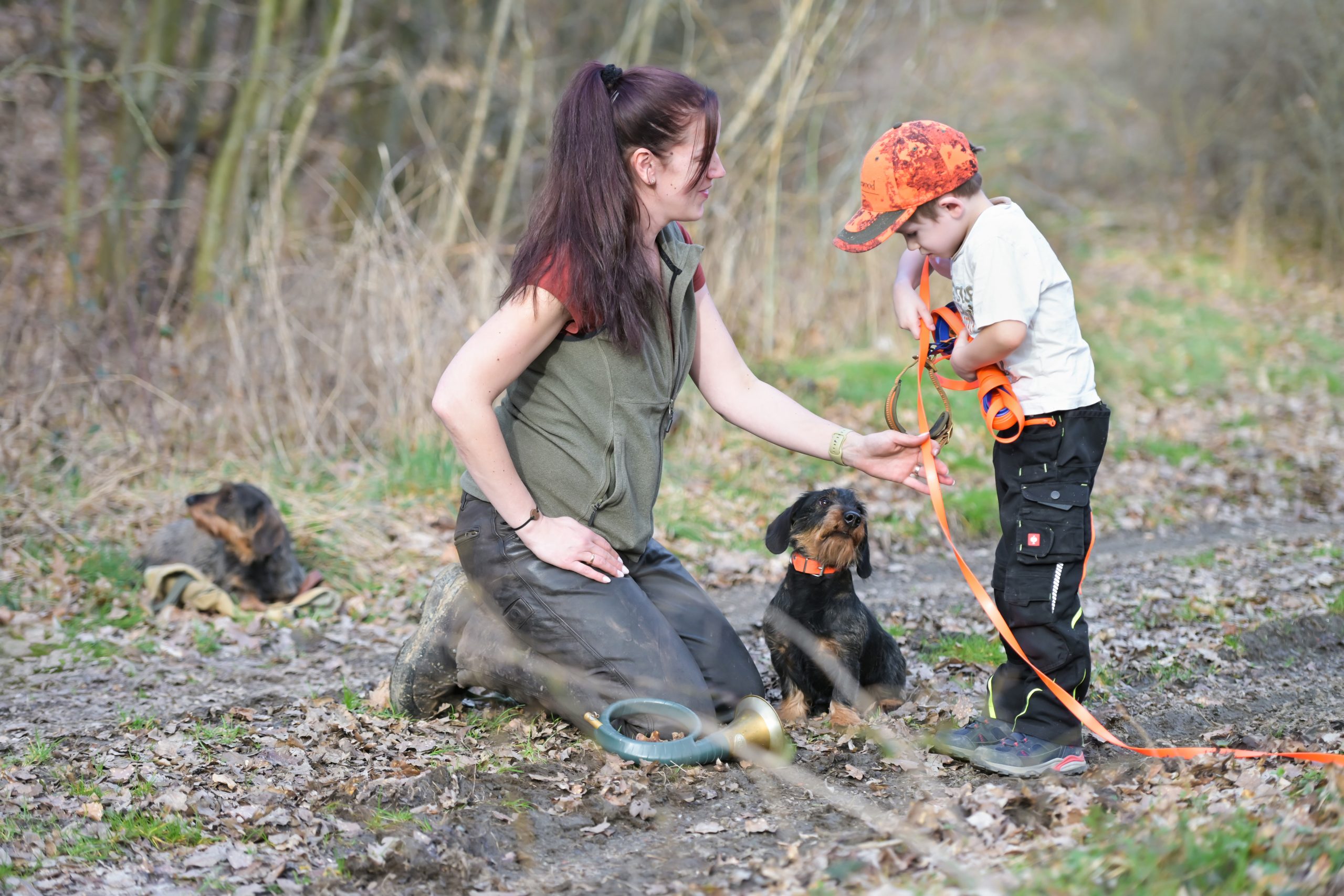
Despite its strong presence in everyday culture, the Teckel’s original role remains highly relevant: hunting. As a working dog, it is still used in various hunting disciplines and contributes to wildlife and nature conservation. Its distinctive anatomy enables it to track game in narrow burrows and dense undergrowth, making its physical characteristics essential to its function.
This functional focus is reinforced by a well-established system of performance testing within the breed. In organized trials, Teckels are not only assessed for their hunting abilities but also compared against one another to ensure that key traits are preserved and continuously developed. These evaluations play a central role in maintaining the breed’s working standards and guiding responsible breeding decisions. In addition, international working competitions attract strong participation and widespread interest, highlighting both the capabilities of the Teckel and the continued relevance of its role across borders.
Responsible Breeding for a Healthy Future
Organized club structures play a central role in ensuring the health and long-term future of the breed. The Deutscher Teckelklub aims to preserve the Teckel’s functionality, temperament, and anatomy through defined breeding standards, health programs, and closely supervised breeding practices across its many groups and sections.
In addition, the associations collaborate with veterinary universities in Germany and abroad as part of ongoing research projects. These efforts aim to identify genetic risks at an early stage and continuously improve breeding practices to ensure the long-term vitality and sustainability of the breed.